Minute to Win It Games for Kids: 25 Easy Setups
August 3, 2026
Minute to Win It games are 60-second challenges built from things already in your kitchen — a stack of cups, a bag of cotton balls, a sleeve of cookies — and they are the single most reliable party filler for kids aged four to twelve. Set a timer, give each kid one minute, cheer loudly, move on. Six to eight games fills a solid 45 minutes of a party with almost no prep and no shopping trip. Here are 25 setups grouped by what they need, plus the running order and scoring tricks that keep it joyful instead of competitive, friend!
How the format works at a kids’ party
The rules are gloriously simple: one player (or one team) attempts one silly task, they get exactly one minute, everyone else watches and yells encouragement. That’s it.
Three things make it work with kids specifically:
- Every round is short. Nobody sits out for long, and a kid who bombs a challenge gets a fresh chance 90 seconds later.
- The tasks look impossible and aren’t. That gap is where the laughing lives.
- You can run it anywhere. Kitchen table, driveway, church hall, backyard. No equipment, no field, no rain plan.
Run games one at a time with a real timer on your phone, visible to the crowd. The countdown is half the fun.
Your supply list, mostly from the kitchen
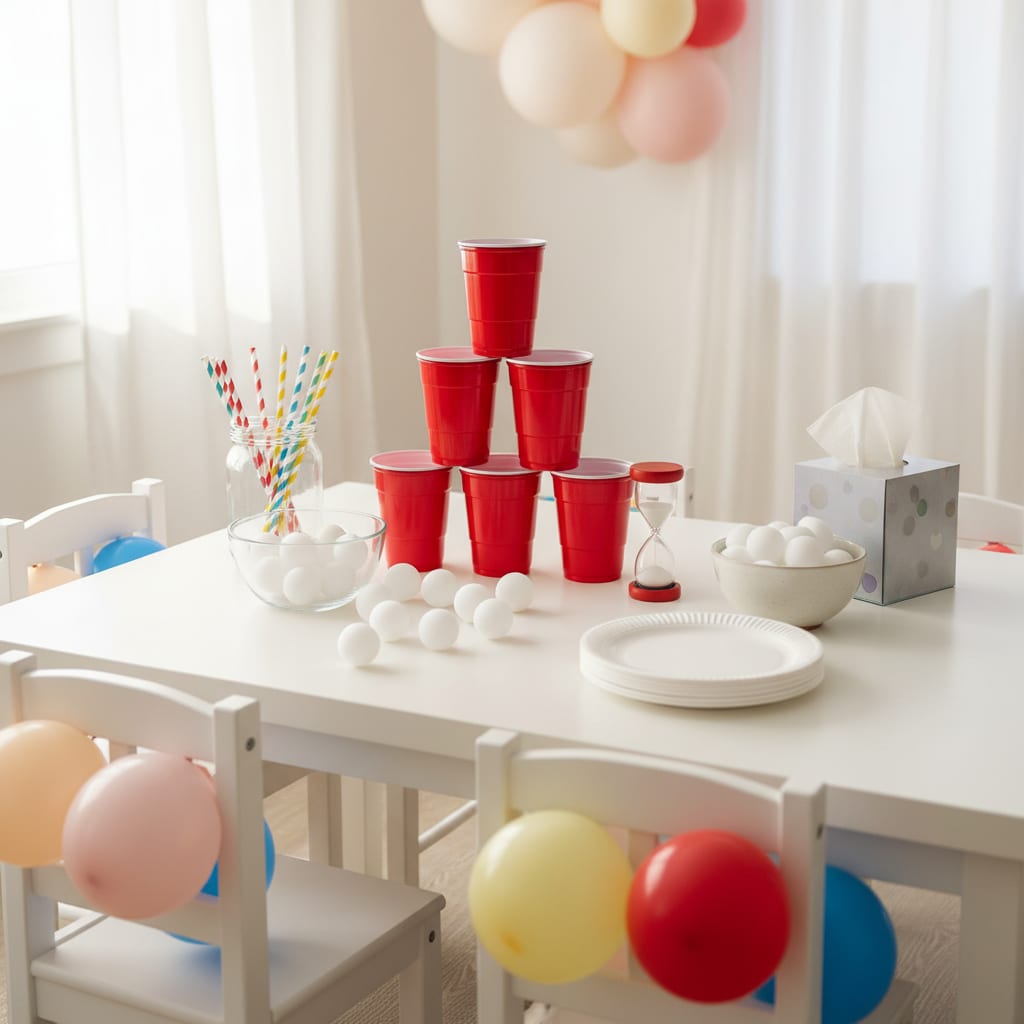
Before you buy anything, raid these: plastic cups, paper plates, straws, cotton balls, balloons, rubber bands, pencils, spoons, tissue boxes, dice, playing cards, masking tape, string, sandwich cookies, dry cereal, marshmallows, pennies and a couple of empty jars.
The one thing worth buying in bulk is ping pong balls, because they turn up in six of the games below and they bounce absolutely everywhere — a bulk pack of plastic pong balls costs less than a bag of themed party favors and lasts through years of parties.
25 games, grouped by what they need
Ping pong ball games
- Ball in a cup — bounce a ball off the table into a cup. Three cups at increasing distances for older kids.
- Blow the ball — move a ball across the table using only a straw. Add a masking-tape lane so it can’t escape.
- Egg carton drop — hold a ball at chin height and drop it into an egg carton cup below. Count how many cups they fill.
- Spoon relay — carry a ball on a spoon across the room and back, as many laps as the minute allows.
- Cup pyramid catch — a partner bounces balls while the player catches them in a cup. Teams of two, great for shy kids.
- Ball float — fill a bowl with water and see how many balls a player can fish out with a slotted spoon.
Cup and plate games
- Cup stack and unstack — build a pyramid of ten cups, then collapse it back to one stack. Pure speed.
- Cup flip — flip a cup off the table edge so it lands upright. Count successful flips.
- Plate spin — keep a paper plate spinning on one finger for as long as possible in the minute.
- Cup shuffle — move a tower of cups from one end of the table to the other one cup at a time, using one hand.
- Stack attack — stack cups rim to rim, alternating up and down. It’s harder than it looks and looks great.
Cookie, cereal and candy games
- Cookie face — put a sandwich cookie on your forehead and move it to your mouth using only your face. The classic, and still the funniest.
- Straw and cereal — transfer dry cereal loops from one bowl to another by sucking them onto a straw.
- Marshmallow toss — a partner tosses marshmallows, the player catches them in their mouth (older kids only, and standing still).
- Candy chopsticks — move wrapped candies between bowls using chopsticks or two pencils.
- Gummy dig — find gummy worms in a bowl of whipped cream with no hands. Bring a towel. Bring several towels.
Balloon games
- Balloon keep-up — keep a balloon off the floor for the whole minute without catching it.
- Balloon stomp — a balloon tied to each ankle, last kid with an intact balloon wins the round.
- Static hair — rub a balloon on your head and stick it to the wall. Little kids find this genuinely magical.
- Balloon race — fan a balloon across the finish line with a paper plate.
Whole-body games
- Junk in the trunk — a tissue box tied around the waist filled with ping pong balls, shaken out by dancing. The undisputed crowd favorite.
- Penny drop — balance pennies on your elbow, then swipe and catch them in the same hand.
- Sticky note sweep — sticky notes stuck all over a player, peeled off by a teammate against the clock.
- Tissue pull — pull every tissue out of a full box, one at a time, one hand only.
- The hanger hunt — untangle a bundle of ten wire hangers into ten separate hangers. Weirdly hard, weirdly satisfying.
Running it without chaos
- Set the table up before guests arrive, with each game’s supplies in its own labeled tray or box. Digging for cotton balls mid-party is how you lose the room.
- Demo each game once, badly. Kids relax the second they see an adult fail at it.
- Two players at a time if you’ve got a big crowd — head-to-head is faster and more fun to watch than one kid at a time.
- Have a designated cheer job for the waiting kids, like counting down the last ten seconds together.
- Stop while they still want more. Six great games beats twelve tired ones, every time.
Age tweaks from 4 to 12
Ages 4–6: drop the timer or make it 90 seconds, skip anything requiring fine motor control (chopsticks, penny drop), and run everything as a group rather than head-to-head. At this age the station format from our toddler-friendly second birthday plan is often a better fit than timed rounds.
Ages 7–9: the sweet spot. Every game on the list works as written, and teams of two keep it social.
Ages 10–12: add a second layer — do the game blindfolded, with the non-dominant hand, or as a two-round tournament bracket. Tweens want the challenge to be actually hard.
Scoring and prizes
Score by rounds won, not by a running points system nobody can follow. Two simple options that both work: everybody plays every game and you tally wins on a whiteboard, or you split into two teams and the team wins together — much gentler for a mixed-age crowd.
For prizes, one small thing per player beats a big prize for one winner: a bouncy ball, a pack of stickers, a fun pencil, a chocolate coin. Let the round winners pick first from a prize bowl and everybody still goes home happy.
These games slot into any theme you’re already running — they’re the filler hour in our Bluey backyard party games plan, and they work beautifully as the indoor half of a glow-in-the-dark party if you swap the ping pong balls for glow bracelets and turn the lights out.
FAQ
What are Minute to Win It games?
Sixty-second challenges built from household items — stacking cups, moving cookies with your face, blowing a ball across a table. One player gets one minute to complete the task while everyone else watches and cheers.
How many Minute to Win It games should you plan for a party?
Six to eight. That fills roughly 45 minutes with demos and cheering built in, which is about the limit of most kids’ attention for one activity block. Prep two spares in case a game flops.
What age are Minute to Win It games good for?
Four through twelve, with adjustments. Under six, lose the timer and play as a group; over ten, add blindfolds or non-dominant-hand rules to keep it challenging.
What supplies do you need for Minute to Win It games?
Plastic cups, ping pong balls, balloons, straws, cotton balls, dry cereal, sandwich cookies, paper plates, tissue boxes and masking tape covers almost every game on this list.
Can you play Minute to Win It games with a small group?
Absolutely. With four or fewer kids, run everyone through the same game at once and compare results, or play in pairs with an adult filling in. It works with as few as two players.
Set a timer, clear the table and let them be ridiculous for an hour — this is the party block nobody forgets. Go win the minute, mama!