Halloween Bingo for Kids: Cards You Can Make at Home
August 19, 2026
A Halloween bingo card is nothing but a grid, a list of 16 to 25 spooky pictures, and a different shuffle on every card — which is why you can make a whole set at the kitchen table in half an hour, without downloading a thing. Below is the item list to copy, the grid size that matches your youngest player, three versions of the game (including one you play while trick-or-treating), the trick that stops two cards being identical, and what to use as markers. Grab a ruler and a marker, friend. This one is genuinely easy.
Grid size by age
- Ages 3–5: a 3×3 grid of pictures. Nine squares, no words, no free space. A round takes about four minutes, which is exactly how long they’ll sit.
- Ages 5–7: a 4×4 grid. Sixteen squares, pictures with the word underneath. Add a free space in one corner if you like.
- Ages 8+: the full 5×5 with a free center. Words only, and you can call cryptically (“the one that lives in a web”) to slow confident readers down.
Mixed ages at one party? Make the 4×4 for everyone. It plays fast enough for the little ones and nobody feels babied.
The 24-item Halloween list
Draw or write these — pick 9, 16 or 24 depending on your grid: pumpkin, ghost, black cat, bat, spider, spider web, witch hat, broomstick, cauldron, skeleton, skull, candy corn, lollipop, candy bucket, full moon, star, haunted house, gravestone, owl, mummy, vampire teeth, monster, scarecrow, autumn leaf.
Stick to shapes a six-year-old can recognise in silhouette. Anything you have to squint at becomes a card nobody can play.
Three versions worth making
Picture bingo — the classic. Call an item, kids cover it. Simple drawings beat good ones; a pumpkin is a circle with a stem.
Word bingo — same list, written out. Good for a classroom party and quietly excellent reading practice, which teachers appreciate.
Trick-or-treat street bingo — the best one. The squares are things you see on the walk: a porch with orange lights, someone dressed as a superhero, a dog in costume, a doorbell that plays a spooky sound, a house handing out full-size bars, a jack-o’-lantern with a crooked smile, a group of teenagers, a fog machine. Kids play it while walking, which is worth its weight in gold on the third block when legs get tired. A pocket-sized card and a pencil on a string, and that’s the whole build.
Making sure no two cards match
Write your items in a numbered list first. Then, for each card, start copying at a different point in the list and work through it in a loop — card one starts at item 1, card two at item 7, card three at item 13. Shuffle the row order too, and by card five nobody can tell they came from the same list.
Make one card per child plus four. Spares cover the kid who spills juice on theirs and the sibling nobody mentioned. Twelve cards is a comfortable party set; a classroom needs 25 to 30.
Drawing them, or printing them
Freehand on index cards is completely fine and takes about a minute per card. If you’d rather they looked bought, rule the grid once in pen, then photocopy the blank grid and fill each copy differently — that’s the fastest route to a matching set.
Ready-made blanks exist too: a pack like these blank bingo cards you write on yourself gives you the grid already ruled on cardstock so you’re only filling squares. And if you’re building your own grid on the computer, the paper weight and print settings that keep the lines crisp are all in how to print party printables at home — 65 lb cardstock is the sweet spot for cards that survive a party.
Markers you already have
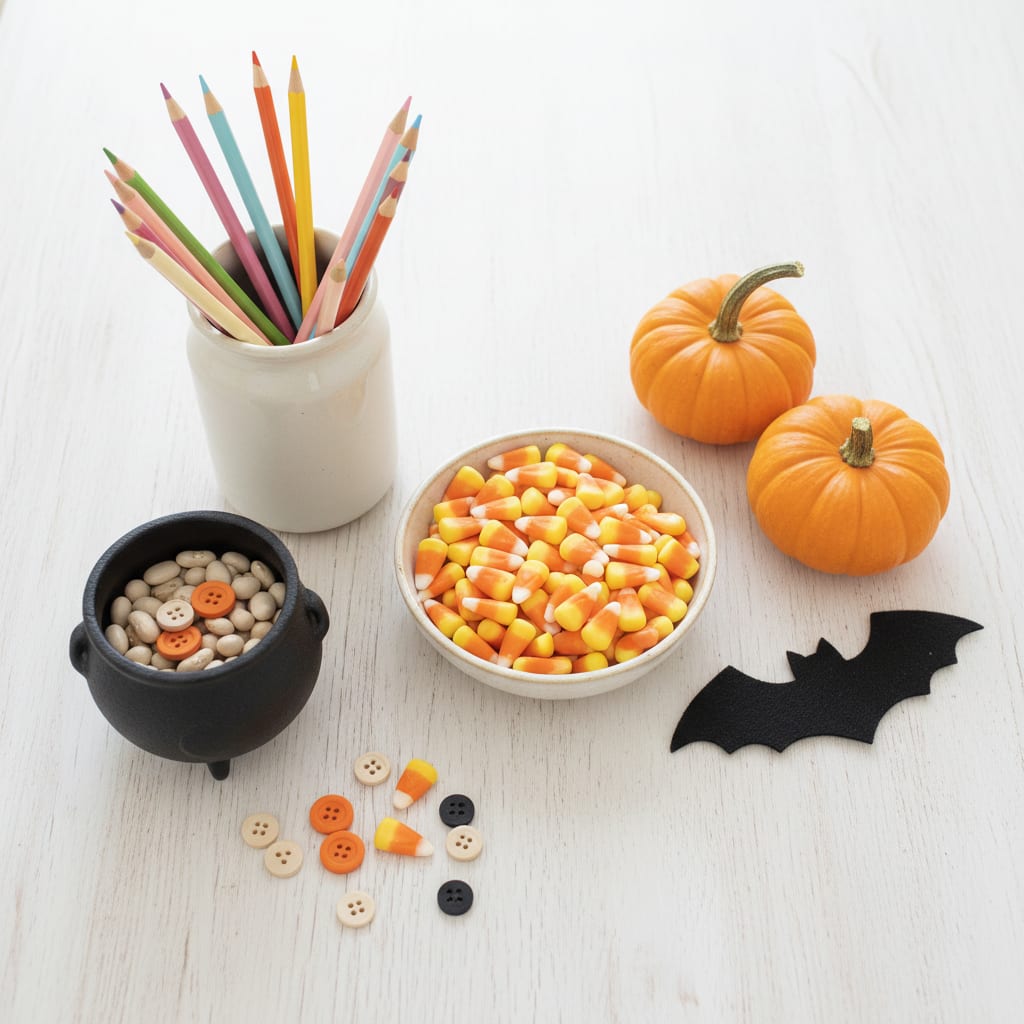
Candy corn is traditional. Cereal loops, dried beans, pennies, buttons, mini erasers, plastic spiders from the party bin, or a plain crayon X all work just as well.
Two upgrades worth the effort: stickers, so cards go home covered in them, and laminating or a sheet protector with a dry-erase marker, which turns twelve cards into twelve cards you use for the next five Octobers.
Running it at a party
Cut your item list into slips and pull them from a cauldron rather than reading down the list — it’s more fun to watch, and it stops you accidentally calling the same thing twice.
Play three short rounds, not one long one: a straight line, then four corners, then a full blackout. Everyone wins something across three rounds, which fixes the losing-child problem entirely. Ten to twelve minutes total is the sweet spot, and it slots neatly between two louder games — the Halloween party games list has the ones to put either side of it.
Prizes stay tiny: a glow bracelet, stickers, a pencil, first pick of the treat bowl. Bingo prizes that outshine the party favors cause more trouble than they’re worth.
In a classroom
Check the allergy rules before you plan candy-corn markers — most rooms now ask for non-food games, and dried beans or stickers solve it instantly. Print names on the back of each card as they’re handed out so lost cards find their owner.
Teachers are usually running 25 kids with 20 minutes, so pre-cut everything, bring your own markers in a zip bag per child, and keep the caller slips in one cup. Sending cards home afterwards makes a sweet, free addition to a boo basket for a neighbour, too.
FAQ
How many squares should a Halloween bingo card have?
Nine for preschoolers, sixteen for early elementary, twenty-five for ages eight and up. Sixteen is the safest single choice for a mixed-age party.
How do you make bingo cards without a printer?
Rule a grid on an index card with a ruler and draw the items freehand, or buy blank pre-ruled bingo cards and fill them in. Change the starting point in your item list for each card so no two match.
How many bingo cards do I need for a party?
One per child plus four spares. For a classroom, count the roster and add five.
What can kids use to cover the squares?
Candy corn, cereal, dried beans, pennies, buttons, stickers or a crayon X. In allergy-aware classrooms, skip anything edible.
How long does a round of Halloween bingo take?
Four to six minutes for a line, ten to twelve for a blackout. Run three short rounds rather than one long one so more children get to shout.
Rule the grids tonight, fill them while something plays in the background, and you’ll have a game that costs nothing and buys you fifteen quiet minutes on the loudest afternoon of the year. Worth every pen stroke!